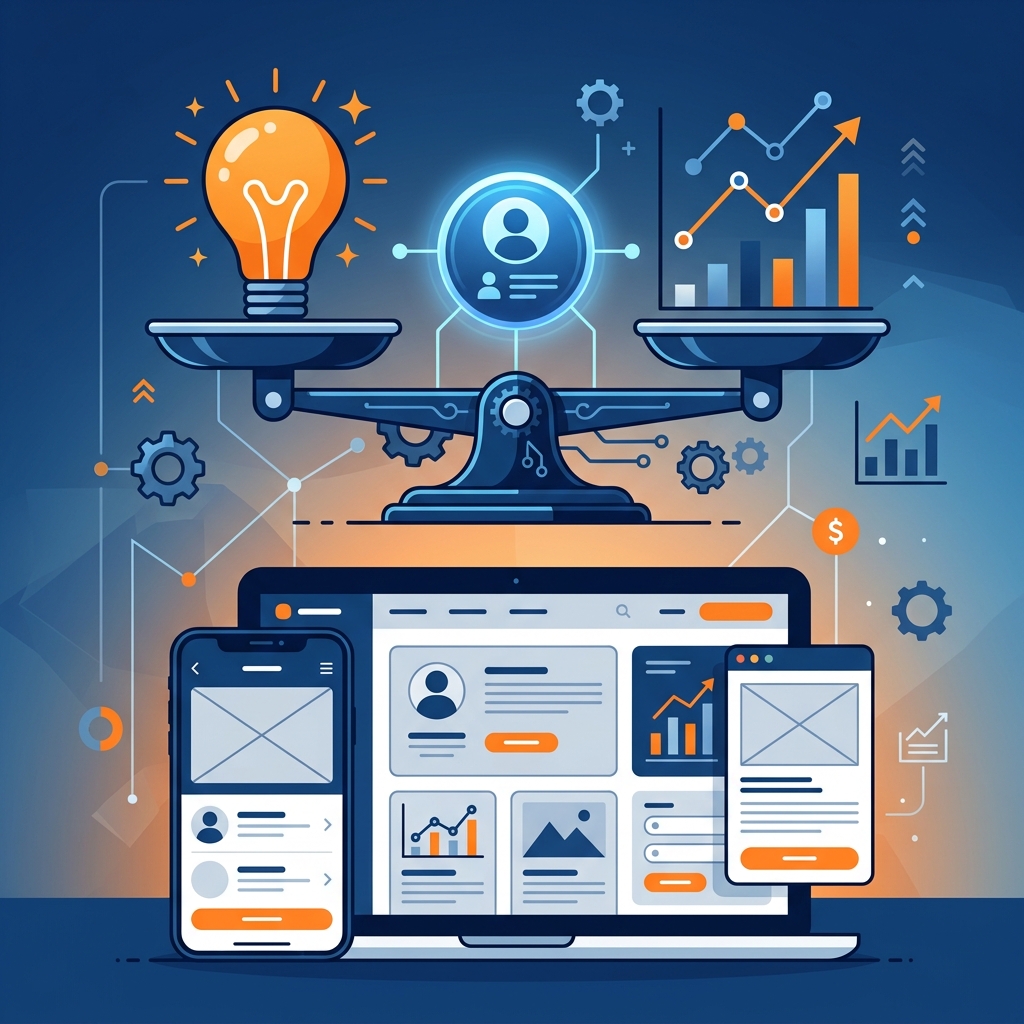
Product Thinking in UI/UX Design: The Key to Building Products That Actually Work
Designing a beautiful interface is easy.
Designing a product people actually use—that’s different.
This is where product thinking in UI/UX design comes in.
Product thinking goes beyond screens and interactions. It focuses on understanding the problem, the user, the business, and the long-term impact of every design decision.
It shifts the mindset from:
👉 “How should this look?”
to
👉 “Why should this exist, and how should it work?”
What Is Product Thinking?
Product thinking is a problem-solving approach that combines:
- User needs
- Business goals
- Technology constraints
to create meaningful and successful products. It’s about designing solutions that are:
In simple terms:
👉 Product thinking is designing with purpose, not just aesthetics.
Why Product Thinking Is Important in UX Design
Without product thinking, design becomes surface-level. Here’s why it matters:
1. Focuses on Solving Real Problems
Instead of adding features blindly, product thinking asks: What problem are we solving? Does this feature actually help?
2. Aligns UX with Business Goals
Great UX isn’t just user-friendly—it also supports: Revenue, Growth, and Retention.
3. Encourages Data-Driven Decisions
Product thinkers rely on: User research, Analytics, and Testing. Not assumptions.
4. Prevents Feature Overload
More features ≠ better product. Product thinking helps prioritize what truly matters.
5. Improves Long-Term Product Success
It ensures the product evolves based on: User feedback, Market needs, and Performance data.
Core Elements of Product Thinking
1. User-Centric Mindset
Understanding: User needs, Pain points, Behavior.
This connects directly to: Empathy, User research, Personas.
2. Problem Definition
Before designing, clearly define: What is the problem? Who is facing it? Why does it matter?
A well-defined problem leads to better solutions.
3. Business Understanding
Design must support business goals like: Conversions, Retention, Engagement.
UX and business should work together—not separately.
4. Data and Feedback
Use: Analytics, A/B testing, and User feedback to validate decisions.
5. Iteration and Improvement
Products are never finished. Product thinking involves:
Testing, Learning, and Improving continuously.
Product Thinking vs Design Thinking
These are related but slightly different. Both are important, but product thinking is broader.
| Product Thinking |
Design Thinking |
| Focuses on product success |
Focuses on problem-solving process |
| Includes business and metrics |
Focuses more on user empathy |
| Long-term product strategy |
Short-term solution approach |
| Data + UX + business |
UX-focused approach |
How to Apply Product Thinking in UX Design
- Step 1: Understand the Problem Deeply - Don’t jump into UI. Ask: What problem are we solving? Is it worth solving?
- Step 2: Know Your Users - Use: User research, Interviews, Personas. Understand real needs.
- Step 3: Define Success Metrics - What does success look like? Examples: Increased conversion rate, Reduced drop-off, Higher engagement.
- Step 4: Prioritize Features - Use frameworks like: MVP (Minimum Viable Product), Impact vs Effort. Focus on what matters most.
- Step 5: Test and Iterate - Launch early → Learn → Improve. This is the core of product thinking.
Real-World Example
Imagine building a food delivery app.
- Without product thinking: Add many features, Complex UI, Confusing experience.
- With product thinking: Focus on quick ordering, Simplify checkout, Improve delivery tracking.
→ Result: Better user experience + higher retention.
Common Mistakes Without Product Thinking
- Designing only for visuals
- Ignoring business goals
- Adding unnecessary features
- Not validating ideas
- Skipping user research
These lead to products that look good but fail in real use.
How Product Thinking Improves UI/UX Design
It helps designers:
- Make smarter decisions
- Prioritize effectively
- Design meaningful features
- Align with business goals
- Create scalable products
It turns designers into strategic thinkers.
Career Impact for UX Designers
Designers with product thinking skills:
- Stand out in interviews
- Contribute to product strategy
- Work closely with product managers
- Build impactful products
It’s a must-have skill for: Startup designers, Product designers, UX leads.
Final Thoughts
Product thinking is not just a skill—it’s a mindset.
It changes how you approach design:
- From screens → to systems
- From features → to solutions
- From UI → to impact
In modern UX: UI makes it look good, UX makes it usable, and Product thinking makes it valuable.